How I Lost 10 Kg within 2 Months, Despite Having Hypothyroidism
Fatigue, Weight Gain, Sleep Deprived — I faced it all
Our body is designed in a way that it can handle sudden changes in food habits, environment, and lifestyle — but if the unhealthy patterns keep repeating for years, they burden the cells that fight infection and weaken our immune system.
Nothing happens overnight, our body keeps signaling us — not just for months but years. In my case, I started having bloating, intestine infections, and tiredness; like I didn’t have the energy to get up from my bed.
I had these symptoms for about a year and then I started gaining weight, and not 3 or 4 kg but 10 kg of weight within a month — I remember my face looking like a balloon.
Initially, I thought it was a happy weight but happiness faded after a few months leaving behind my weight. Things got alarming when my sister pointed out that my neck was swollen and I should get it checked.
Finally, I took the test and my Thyroid Function Tests (TFTs) result came — and as guessed, I was diagnosed with hypothyroidism. So, basically in adults thyroid level should be between 0.27 to 4.2 uIU/mL — and don’t be surprised but mine was 27 uIU/mL — and the doctor was “How can you directly land from single digits to twenties — that means it was developing in your body for past 3 to 4 years — you had a history of bloating and abdomen infection, why didn’t you get checked?”
What shocked me more was the key cause for hypothyroidism, which by the way is Stress — you heard it right — stress is not only responsible for insomnia or anxiety — it messes with the hormones which leads to digestive issues, breathing problems, fertility dysfunction, menstrual cycle, excess hair fall, weight gain/loss, and even allergies.
And that is true, for some personal reasons I was stressed for more than 3 years, and after Covid, my physical activities were almost zero — plus I skipped lunch and most of my breakfast. I started having sugar cravings, not just during periods but like 80% of the time, which is again a sign that something is wrong with my body.
Initially, I panicked for almost a month and didn’t know where to start or what to do, but eventually, I had to figure out some routine to manage the thyroid level or it could get worse.
I started going for a walk and created a calendar. However, nothing was going back to normal, because I was missing the crucial thing — not taking stress — It took a few months to realize how our mental health and physical health are dependent on each other and you have to balance both of them to make a difference in your life.
So, this is how I took care of my — Mental Health
1. Meditation
I know meditation is back-breaking for many, to focus on something but rather end up feeling more distracted — so, I found a technique that did a great job — all you have to do is make the ‘HMM’ sound from your throat and not from your nose followed by keeping your hands on your chest to feel that sound. This is a vibration technique where the Hmm sound can be felt in most of your body parts, calming the nerves and freeing up space for positivity. One can do this for a minimum of 5 to 10 minutes.
2. Pranayam (Yogic Breathing Technique)
I was not a fan of pranayam but a few of my friends suggested it and I saw the result just after a week. It controls the fluctuations of our mind and is a natural gift to improve the respiratory system. You can start by inhaling from the left nostril — hold it for 8 to 10 seconds — and exhale from the right nostril. Try doing it 10 times and witness a super you within a week.
There are also some yoga poses that can relieve stress and improve thyroid, such as — bitilasana marjaryasana (cat-cow pose), ustrasana (camel pose), suryanamaskar, bhujangasana (cobra pose), chakrasan (upward wheel pose), and shavasan (corpse pose).
This is how I took care of my — Physical Health
3. 30 Minutes of Brisk Walking
Brisk walking in the evening and morning transformed my health and brought the shape I had before hypothyroidism. To be frank, I’m not a gym person, so I took the ‘recommended by doctors’ and saw that my belly fat started reducing. For people who rarely get up from their work desk — walking 30 minutes every day is the bare minimum to boost an active lifestyle.
4. Healthy Diet
his is a bit tricky one — what to eat and what to avoid — so, even if you don’t have thyroid but bloating or digestive issues start by avoiding cruciferous veggies like cauliflower, cabbage, and broccoli. Soy also negatively impacts the function of the thyroid, as per research along with processed and fast food, so it is better to avoid taking risks.
Also, if you feel bloating or cramping after having dairy or gluten products then try avoiding those as well — I’m sensitive to dairy products (lactose intolerant) and that was the main reason for my intestine infection. But, if you really love having milk then switch to almond milk, it can be a bit pricey but a good alternative.
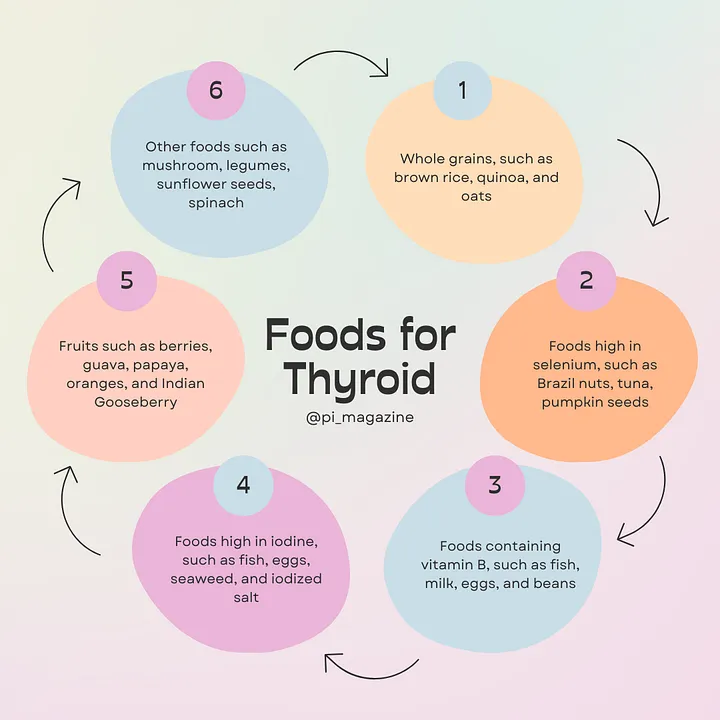
Now, coming to the food that one should consume during hypothyroidism — seeds and nuts for antioxidants (brazil nuts for selenium, pumpkin seeds for magnesium, and sunflower seeds for vitamin E) — green leafy vegetables (spinach for iron and vitamin A) — Avocado to balance hormone and blood sugar level — Mushroom (selenium and a mineral in the conversion of T4 and T3, thyroid glands) — Iodine-rich foods (seafood and egg) — Fruits (berries for antioxidants, orange and pineapple for vitamin C, apple & pears to detoxify the body)
Believe me, these are the things that I followed for a month and saw an amazing result and I hope it some how makes your life simpler as well.